

In an era where tech giants are racing to label every product "AI-first," Canonical is charting a different course for Ubuntu. Rather than a sudden overhaul or a single monolithic "AI Release," the roadmap for the next year reveals a strategy defined by maturity, local processing, and open-source integrity.
Based on recent insights from John Seeger, Canonical’s VP of Engineering for Ubuntu, here is a look at how AI will and won’t be arriving on your desktop.
A "Maturity-First" Philosophy
The most striking aspect of Canonical’s approach is its restraint. Unlike other enterprise Linux vendors who are positioning AI as the core platform feature, Ubuntu is maintaining its identity as a general-purpose OS.
AI features will land in Ubuntu only when they are deemed stable and high-quality. There are no arbitrary targets for code generation or token usage. Instead, the focus remains on engineering discipline: using AI where it makes sense and avoiding it where it doesn’t.
The Two Pillars: Implicit vs. Explicit AI
Canonical categorizes its future AI work into two distinct buckets:
Implicit AI (The Invisible Boost): These are background enhancements that improve existing features without changing how you use the OS. Think of smarter accessibility tools, refined speech-to-text, and more capable screen readers. These features use AI to do a traditional job better.
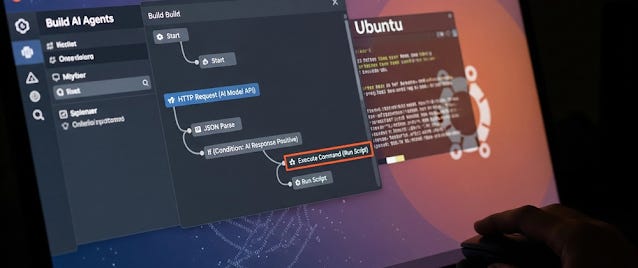
Explicit AI (The Agentic Workflow): These are more visible, proactive tools. This includes assistance with system administration, automated troubleshooting, and document creation. Because these features involve "agentic" behavior—actions taken on behalf of the user—Canonical is prioritizing security and confinement before they are widely released.
Privacy Through Local Inference
A major differentiator for Ubuntu is the "bias toward local inference." Whenever possible, AI tasks will be handled by your own hardware rather than a remote server.
To make this user-friendly, Canonical is leveraging Inference Snaps. These allow users to install models optimized specifically for their hardware (like a particular GPU or NPU) without manual configuration. Because these run within the Snap confinement framework, they are restricted by the same security rules as other Ubuntu software, ensuring your data doesn't leak to the model.
Canonical is favoring "open weight" models. While not always "open source" in the traditional software sense, these models provide a level of transparency and licensing that aligns more closely with Ubuntu’s community values. By combining these models with open-source harnesses, the goal is to build an AI ecosystem that remains auditable and accessible.
Control and the "Kill Switch" Question
Will there be a way to turn it all off? While Seeger noted that Ubuntu will not run models in the background "for the sake of it," a single "Global AI Kill Switch" is unlikely. Given the modular nature of Linux where AI might be embedded in anything from a translation tool to a driver—a single toggle is technically impractical. However, the opt-in nature of many of these features (like Inference Snaps) ensures users remain in the driver's seat.
Ubuntu isn't becoming an "AI OS"; it’s becoming a more capable OS that happens to use AI. By focusing on local execution, snap-based security, and a measured rollout, Canonical is ensuring that the future of Ubuntu remains consistent with the standards of privacy and quality that users have expected for two decades.