

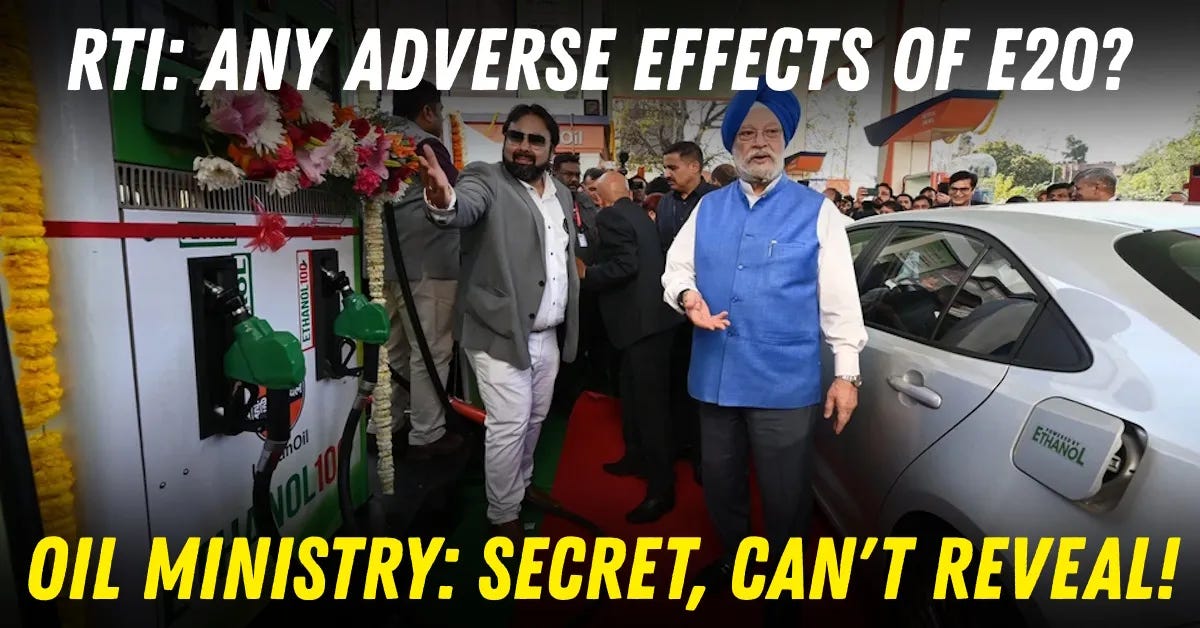
There is an old, unwritten rule in public relations: If the data makes you look good, you shout it from the rooftops. If the data proves you’re ruining people’s property, you declare it a national secret.
Welcome to the absolute circus of vehicle ownership in India, where we are currently being forced to participate in a mandatory, unvetted national science experiment. As of this year, the complete national rollout of E20 petrol (a 20% ethanol blend) is in full swing. If you own a legacy vehicle, meaning practically any car or motorcycle manufactured before April 2023 you’ve likely already noticed the symptoms. Rough idling. A sudden, unexplained drop in fuel mileage. Engines gradually choking out and stalling mid-ride.
Naturally, citizens wanted answers. What does this aggressive push for ethanol actually do to a normal, mass-market engine over time?
So, an ordinary taxpayer decided to use the law. They filed a Right to Information (RTI) request demanding the official research reports from the Automotive Research Association of India (ARAI) regarding the long-term, adverse effects of E20 fuel on vehicle engines.
The response from the Petroleum Ministry? “It’s a secret. We can’t reveal it.”
Let that sink in. ARAI is a taxpayer-funded institution. They used our money to conduct joint research with the Indian Institute of Petroleum and Indian Oil to study exactly how corrosive this fuel is. Yet, the government claims that the results are “confidential” and cannot be shared with the public.
The absolute audacity is staggering. If the ARAI report proved that E20 fuel was completely harmless to older engines, Union Road Transport Minister Nitin Gadkari would be plastering the data on massive highway billboards. They’d be bragging about it across every media channel, making shiny flyers to celebrate their green milestone. The only reason to hide this data behind a wall of “confidentiality” is because the truth is damning. The data undoubtedly proves what everyday riders are experiencing: E20 fuel is systematically destroying legacy engines.
This isn’t a conspiracy theory; it’s an open secret that the government itself has admitted to in the past. If you dig up NITI Aayog’s official 2021 Ethanol Roadmap), the admissions are right there in plain text:
Material Degradation: The report explicitly admits that E20 fuel degrades rubber fuel lines, swells seals, cracks gaskets, and corrodes old aluminum or steel fuel tanks due to moisture absorption.
The Mileage Tax: It openly states that vehicles not calibrated for E20 will suffer an automatic drop in fuel efficiency.
The Ignored Safety Net: The roadmap originally recommended that Oil Marketing Companies (OMCs) continue to provide a supply of unblended, normal petrol at pumps to protect the nation’s older vehicle fleet.
Instead, the ministry threw that safety net out the window, completely ignoring their own directives on the ground. They phased out normal fuel options, effectively cornering millions of motorists into pumping a corrosive solvent into engines that were only ever designed to handle a maximum of 10% ethanol.
Nitin Gadkari loves a grand, sweeping narrative about a green future, energy independence, and boosting the agricultural economy. But let’s call it what it actually is: a massive, forced wealth transfer from the pockets of ordinary, middle-class vehicle owners straight into the pockets of the sugar and ethanol lobby.
If you bought a BS6 motorcycle or car in 2020 or 2021, you bought a machine built perfectly to the legal standards of the day. Now, you are forced to watch its fuel lines rot and its combustion fail, all while the government stonewalls the exact scientific data that explains why it’s happening.
The RTI Act has been turned into a joke, treated with vague and evasive replies whenever citizens demand basic accountability. We aren’t asking for defense secrets or state intelligence; we are asking for the technical data on the fuel we are paying for at the pump.
If a government is truly confident in its policies, it operates with transparency. When it hides its own taxpayer-funded research behind closed doors, it tells you everything you need to know. Your engine is suffering, the data proves it, and they just don’t want you to read the receipt.