
Net Neutrality 2.0? Why Airtel’s "Priority" Terms and Conditions Should Worry Every Prepaid User
Airtel Priority Exploits the Fine Print of India’s Telecom Laws

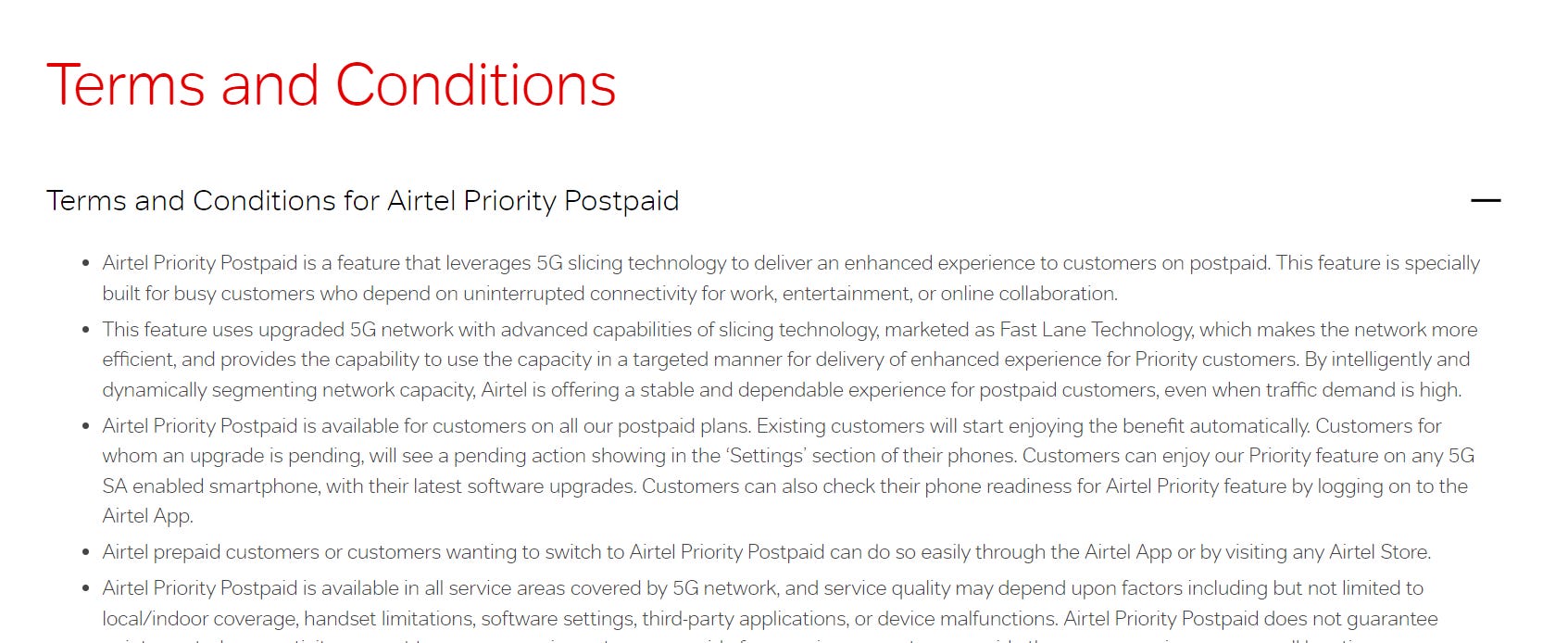
Airtel’s newly launched "Priority Postpaid" feature has ignited a major legal and regulatory debate in India. By utilizing 5G Standalone (SA) network slicing—marketed as "Fast Lane Technology" Airtel promises a premium, stable connection to postpaid users even during peak traffic hours.
While the telecom operator insists it remains fully compliant with existing laws, a closer look at the fine print reveals that the terms and conditions are carefully engineered to exploit a massive, decade-old regulatory blind spot in India’s telecom framework.
1. The Content vs. Class Distinction
The bedrock of India’s 2016 Net Neutrality regulations is the strict ban on content-based discrimination. Telecom operators are legally prohibited from prioritizing or throttling specific apps (e.g., making one streaming app load faster than a competitor).
Airtel’s terms state that its network slicing “segment[s] network capacity” dynamically, completely ignoring what app a consumer is using. Because current Telecom Regulatory Authority of India (TRAI) laws mandate equality across applications but are silent on equality across user profiles, Airtel has bypassed net neutrality on a technicality. They aren’t picking favorite apps; they are picking favorite customers.
2. Rewriting the Definition of Traffic Management
Under current rules, telcos are allowed to use Traffic Management Practices (TMPs) to temporarily manage network congestion and optimize spectrum efficiency.
Airtel’s fine print heavily relies on technical terminology, framing 5G network slicing as an architectural upgrade that makes the network “more efficient” by using capacity in a “targeted manner.” By dressing up a commercial tier as a “technical optimization feature,” Airtel shields itself from accusations of artificial throttling. They argue they are simply optimizing the highway, even though they are actively setting up a toll booth for the express lane.
3. Exploiting the “Specialized Services” Loophole
When India’s net neutrality rules were written, 5G did not exist. The regulations left a vague, necessary exemption for “Specialized Services”—isolated virtual network pipes required for critical enterprise use cases, such as remote robotic surgeries, smart grids, or autonomous vehicles.
Because TRAI and the Department of Telecommunications (DoT) never formally defined the precise legal boundaries of what constitutes a “specialized service” on retail spectrum, Airtel has adapted this enterprise-grade technology for retail consumers. It is a highly profitable legal gray area.
4. Weaponizing the “Zero-Sum” Nature of Spectrum
Unlike fixed fiber broadband—where an internet service provider can easily pump more data through a line—mobile networks operate on a finite, shared public resource: wireless spectrum. Mobile internet is a zero-sum game; if one person gets a guaranteed slice of the airwaves during high demand, it technically leaves less capacity for others.
Airtel’s terms insulate the company from this reality by adding sweeping liability waivers. They state that the service “does not guarantee uninterrupted connectivity” and depends on “handset limitations” or “indoor coverage.” This legal padding protects Airtel from consumer court lawsuits if a postpaid user experiences poor speeds, while simultaneously masking the fact that ordinary prepaid users are the ones bearing the brunt of the spectrum reallocation.
5. The “Ejector Seat” Clause
Perhaps the most telling aspect of the terms and conditions is how Airtel shields its business model from future legal crackdowns. The fine print explicitly states that Airtel reserves the right to amend or discontinue the feature at any time without prior notice, specifically citing potential incoming guidelines or regulations from TRAI or the DoT.
By building this regulatory escape hatch directly into the consumer contract, Airtel can harvest high-ARPU (Average Revenue Per User) postpaid migrations today, knowing that if regulators eventually wake up and close these loopholes tomorrow, the company can pull the plug on the service with zero contractual liability.