
Linux Kernel 7.1 Is Here
Here's what it actually means if you're running Linux on modern AMD, Intel, or Apple hardware.

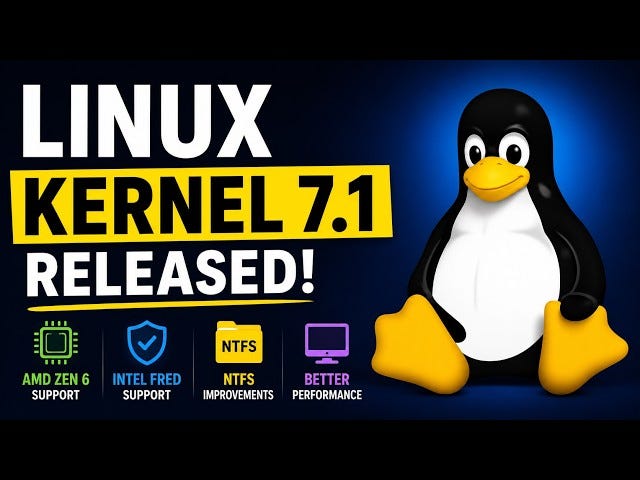
Another month, another kernel, except this one actually earns its changelog. Linux 7.1 has officially arrived, and if you’re running on recent AMD, Intel, or even Apple silicon, this isn’t one to scroll past. Let me walk you through why it matters and whether you should care.
This release lays the groundwork for next-gen AMD Zen 6 chips (yes, the ones you can't actually buy yet but Linux is nothing if not eager) along with a fresh round of optimizations for Intel, especially Intel’s FRED (Flexible Return and Event Delivery) which is a gloriously bureaucratic name for “the kernel now handles interrupts and exceptions like an adult.” The result is better performance and better security at once, which is the rare upgrade that doesn't make you choose between the two.
NTFS Improvements under the Hood
Reading and writing Windows partitions just got noticeably more reliable and compatible. If you dual-boot or constantly shuffle files off a Windows drive, this improvement alone might justify the update.
There’s more foundation laid for future AMD and Intel GPUs, plus early support for additional HDMI 2.1 features. Translation: nothing flashy today, but your future self will quietly thank this release.
Virtualization Improvements
Updates to KVM and other virtualization components make VMs and cloud workloads a little leaner and more efficient exactly the kind of steady gain that adds up over time. In addition, there’s driver updates, bug fixes, and security hardening that nobody tweets about but everybody benefits from.
A kernel release doesn’t mean it’s yours yet. If you’re on a rolling release like Arch or openSUSE Tumbleweed, you’ll get 7.1 soon (smugly, as always). Everyone on a fixed-release distro gets to practice a little patience while it works its way into stable repos.
Are you hyped for the new hardware support and performance bumps, or are you waiting until it’s been properly battle-tested? Drop your thoughts in the comments below. 👇
If you found this useful, consider subscribing — I cover the latest in Linux and open-source, minus the hype.