
India's Accountability Deficit: Why Trackers Like IndiaWatch Matter
There is something quietly radical about a website that simply keeps score.

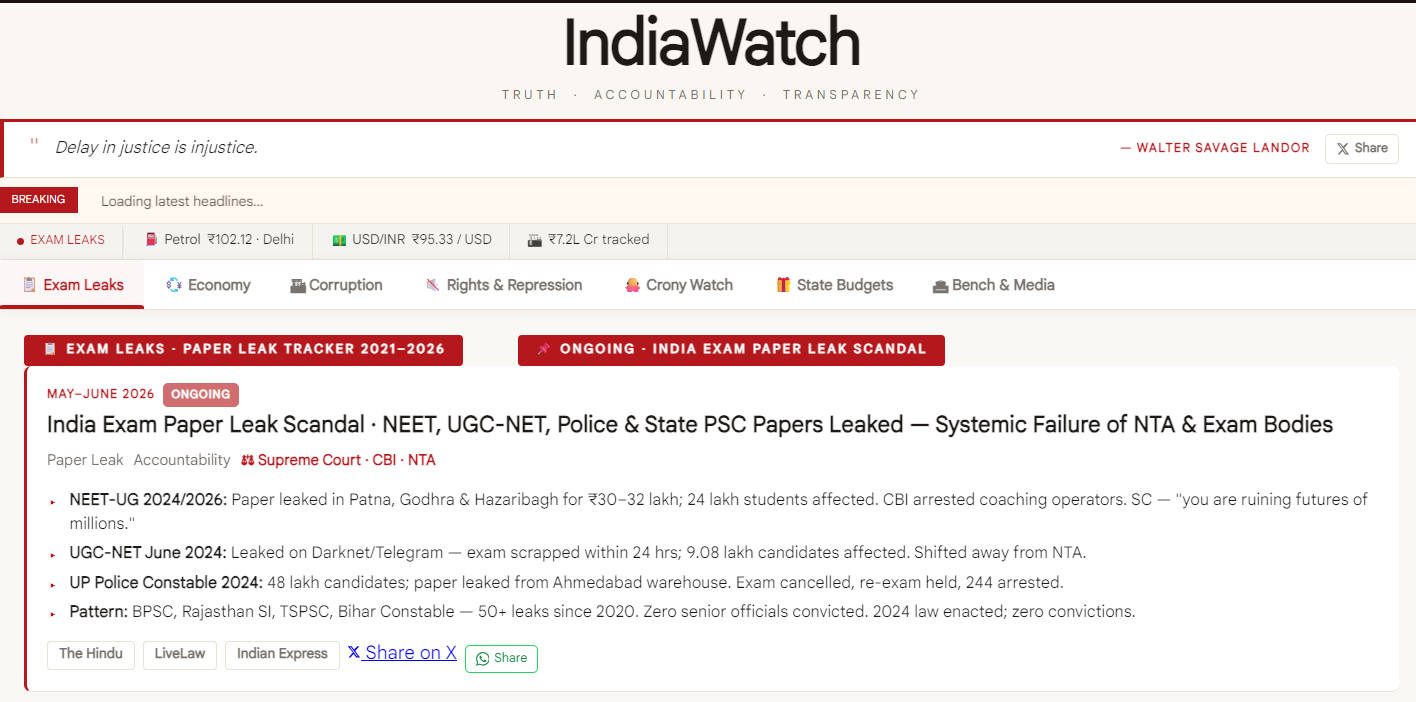
IndiaWatch does not editorialize in the traditional sense. It lists numbers: 50+ journalists arrested since 2014. 65+ RTI activists killed or attacked. 7,000+ URLs blocked under the IT Act. Zero convictions in RTI killings. Zero cases investigated by the Lokpal since its appointment in 2019. The numbers speak; the site mostly steps aside.
And yet, the cumulative picture those numbers paint is damning.
The creeping acceptance of irresponsibility
The most compelling section of IndiaWatch is its dissection of the Right to Information (RTI) Act, once described as the most powerful tool available to India’s 1.4 billion citizens. The site documents, year by year, how the law was not repealed but defanged: commissioners made dependent on the executive (2019), a new privacy exemption that swallows the public interest override (2023), a Whistleblower Protection Act that has sat inoperative for a decade, and a Lokpal that has investigated precisely nothing.
This is the sophisticated face of democratic backsliding. It does not announce itself. It arrives as an amendment here, a vacancy left unfilled there, a court petition quietly dismissed. By the time citizens notice, the instrument is already blunt.
The PM CARES Fund is the starkest example. Over ₹10,000 crore in public donations, raised during a pandemic, when citizens had no real choice but to trust, structured specifically to be beyond CAG audit, beyond RTI, and beyond parliamentary oversight. The Supreme Court’s acceptance of the “private trust” framing, despite the Prime Minister serving as its chairman, represents a failure of institutional imagination that IndiaWatch rightly highlights.
The Value of Keeping Score
Accountability journalism in India faces enormous headwinds: defamation suits, UAPA charges, revenue pressure, and outright arrests. In that environment, a site that aggregates verified public records and court orders into a single, navigable tracker performs a function that is both modest and essential. It makes the cost of impunity visible.
Critics will argue that IndiaWatch presents a one-sided picture, that it focuses on the BJP government while ignoring comparable failures under previous administrations. That is a fair challenge. Accountability should not be partisan. The RTI Act was passed under a Congress government; political parties of all stripes have resisted compliance with it. A fuller picture would track institutional decay across governments, not just the current one.
But the counter-argument is also fair: someone has to start somewhere. The data IndiaWatch cites - RSF rankings, CPJ records, CIC pendency figures - are not invented. They are sourced. If the picture is incomplete, the answer is more tracking, not less.
India is the world’s largest democracy. Its trajectory matters not just for its 1.4 billion citizens but as a signal to democracies everywhere about whether accountability institutions can survive sustained executive pressure. The pattern IndiaWatch documents, laws weakened by amendment rather than repeal, watchdogs starved of resources, courts deferring on structural conflicts of interest is not unique to India. It is a playbook.
Check out the website: https://indiawatch.net/