
How a decades old system became Indispensable to Indian Logistics
"Older Than the Internet - Yet It Powers Every Delivery in India"

You know, long before those instant deliveries and all our online shopping habits, there was this simple numbering system. It actually tackled one of India’s really big logistical headaches. And get this, it’s still handling millions of deliveries every single day.
Think about your Blinkit groceries arriving in just minutes, or your Swiggy order finding your exact doorstep without any mix-ups. Even your Amazon package gets to the right address, no problem, even in a city jammed with countless streets.
What’s behind all this? It’s something so ordinary, most of us barely even notice it anymore: a six-digit PIN code. This system has been quietly running India’s postal and delivery network for well over fifty years now.
Before the PIN code showed up back in 1972, India’s postal service was dealing with a surprisingly tough problem. The same city could be spelled in so many different ways. Bombay, Mumbai, Bambai – all the same place, right? Across the whole country, tons of towns had the exact same names, and then you had spelling variations happening across different languages and regions.
For the people sorting the mail, it was a nightmare. One mail sorter might have to memorize over 4,000 post office names just to do their everyday job. And as the amount of mail kept growing, so did the chances of delays, confusion, and stuff going to the wrong place.
Then came this cleverly simple fix.
Someone in the Ministry of Communications, a guy named Shreeram Bhikaji Velankar, suggested ditching words and using numbers instead. Instead of relying on spellings and place names, every single location would get a unique six-digit number. We know it today as the PIN code, short for Postal Index Number.
The genius of it is really in how straightforward it is.
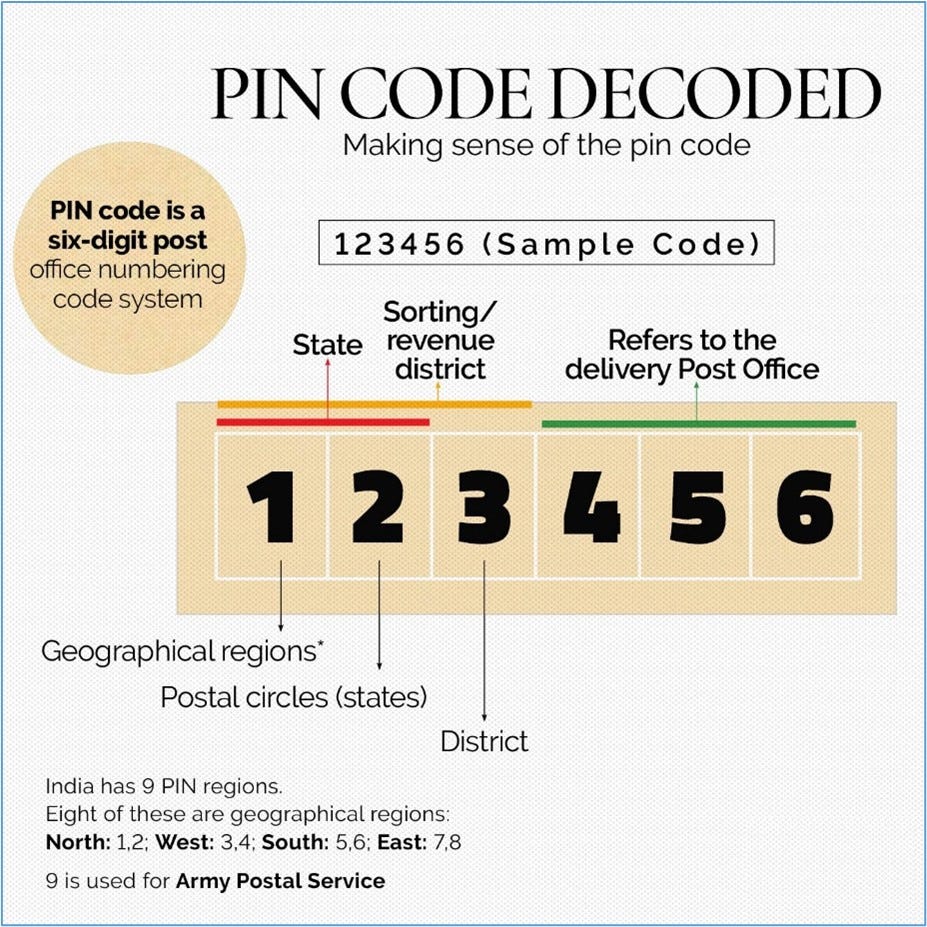
Each number actually means something.
The first digit tells you which postal region it’s in.
The second digit points to a sub-region.
The third digit identifies the sorting district.
And then, the last three digits pinpoint the exact post office that’s responsible for getting it delivered.
Six numbers. One clear address.
What seems like such a tiny detail on an envelope, or on that checkout page you fill out, actually became one of the most critical parts of India’s entire infrastructure.
Today, this same system isn’t just supporting India Post. It’s also the backbone for all the modern logistics networks that e-commerce sites, food delivery apps, courier companies, banks, government services, and even emergency communications rely on. Billions of letters, documents, and packages have found their way to the right spot because of those six little digits.
We’re always talking about breakthrough technologies, but some of the most impactful innovations aren’t the flashy ones. They don’t grab your attention. They just become so dependable that we eventually stop thinking about them.
India’s PIN code is definitely one of those rare inventions.
It was designed over 53 years ago, and it’s still solving a problem that technology alone could never completely fix: making sure every address can be found, understood, and reached.
Sometimes, the systems that really hold a country together aren’t the ones that make the headlines.
They’re the ones just quietly getting the job done, every single day.